Two tools for a parcel in motion
Both run entirely on this page, no account, no lookup
Policy and interface examples below come from official captures checked on 10 October 2026. Timings are published indications, not guaranteed delivery dates. Older UI amounts, offers and routes are illustrative; current order terms and checkout govern. Open an image for full size.
Two questions produce most of the worry in this hobby: what does this tracking phrase actually mean, and how do packed dimensions compare with actual weight. Both have mechanical answers.
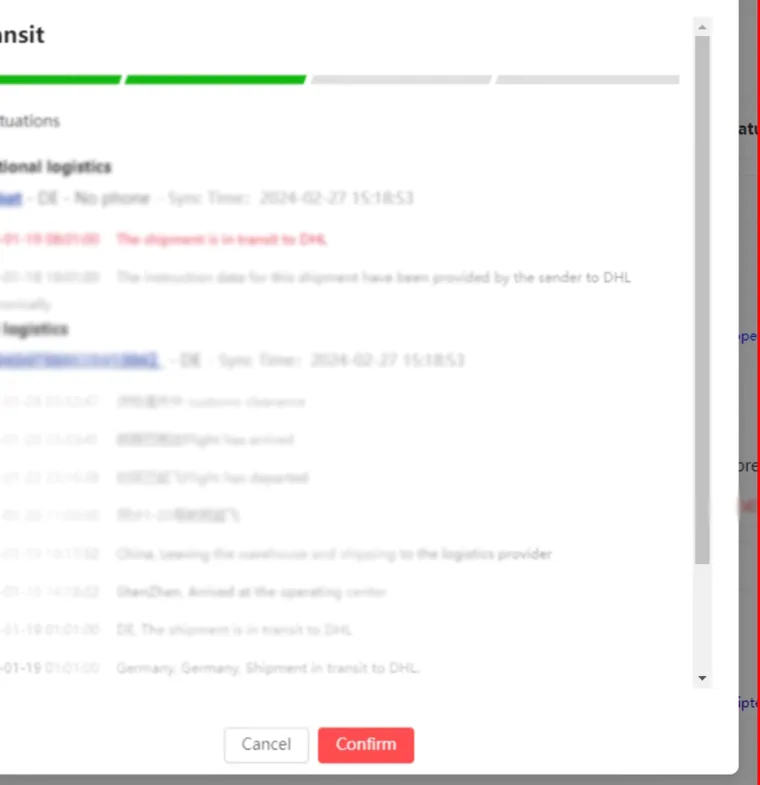
The status decoder
Pick the phrase your tracking page shows. The decoder explains a likely stage and what record to check next. It does not look up your parcel or establish its current location. Phrases follow the operator's own event wording, like the real timeline in the screenshot.
The chargeable weight checker
Enter packed dimensions and actual weight, then select the rule printed for your route. Dimensional weight is length × width × height in centimetres divided by that route’s divisor. Some routes compare actual and dimensional weight; others use actual weight. This tool does not include route minimums, rounding, size limits, goods eligibility or a freight quote.
A worked example: a 40 by 30 by 20 cm box at 1,800 g actual comes out at 4.8 kg volumetric on the 5000 divisor, so the comparison returns 4.8kg before any route minimum or rounding, more than twice the scale weight. Squash the same goods into 40 by 30 by 10 and volumetric falls to 2.4 kg. That is the arithmetic behind the warehouse's compression habit, and behind the 18-yuan rehearsal that tells you the packed numbers in advance.

Reading an estimator results row
The official estimator is public and needs no account: destination, weight in grams, goods type, optionally the three dimensions. Every result row carries four things worth reading in order: the price, the transit window, the line characteristics paragraph, and the greyed-out state. The characteristics paragraph is the densest, since it is where a route discloses battery rules, clearance style, the Amsterdam triangle on German lines, house-number requirements and return behaviour. Some greyed rows in the captured run show minimum-weight refusals, printed with floors like 2000, 2501 or 5001 grams.
The movement is not noise from this side of the counter: the estimator's own disclaimer says the non-proprietary lines are run by third-party logistics firms that reprice with the market, with advance notice promised for changes. A quote is a reading of a moving dial, which is why each one on this site carries its capture date.
Prices move constantly, which is why this site quotes them only as dated examples and links the estimator everywhere a number would otherwise rot.