
Border and sky, the checkpoints a parcel cannot skip
Leg two of three, stops 05 to 07
Policy and interface examples below come from official captures checked on 10 October 2026. Timings are published indications, not guaranteed delivery dates. Older UI amounts, offers and routes are illustrative; current order terms and checkout govern. Open an image for full size.
The sealed box now leaves the operator's hands. A courier truck, an X-ray belt, an aircraft pallet and a customs shed all handle it in turn, and none of them answer to the agent. This leg is where a parcel can be stopped, opened or sent back, so it pays to know what each checkpoint is physically looking for.
An agent cannot promise that screening or customs will finish by your preferred date. Support can still clarify a handover, request records or assist under the selected route’s terms. Your useful action depends on the actual event: a missing scan, a document request and a failed delivery need different responses.
the courier cage
Carrier collection follows warehouse dispatch
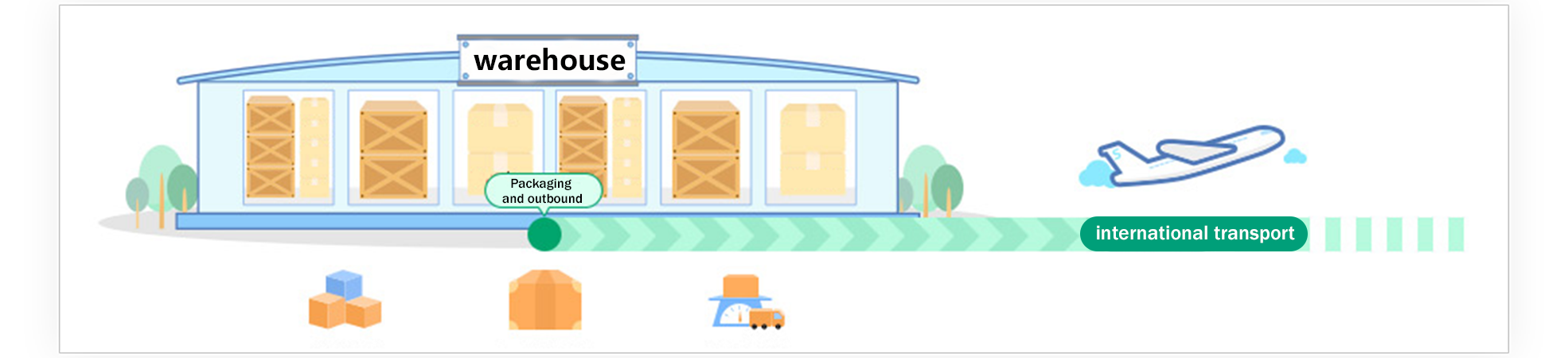
The captured help describes warehouse dispatch within 24 hours and third-party collection within two working days, with weekends and Chinese public holidays affecting collection. These are published processing indications. An account marked shipped does not itself prove the carrier has scanned or collected the box; compare the separate handover event.
At the operating centre the box is scanned into the carrier's own system, and from that scan on, two timelines exist: the platform's order events and the carrier's waybill events. They disagree on timing because they are different machines logging different doors; the modal on the doorstep page shows both stacked. A sort here is also where consolidated freight is built into airline containers, which is why one pallet-mate's problem can idle a hundred innocent boxes.
A box can bounce straight back from this cage for a size reason: if, even after compression, it exceeds the dimensional limit of the route you picked, the floor returns it and messages you to choose again. Routes also carry minimum weights, with floors of 2000 g, 2501 g or 5001 g on several UPS and UK lines, so a very light box can be refused by the route you wanted.
the security belt
Aviation screening rejects three kinds of cargo
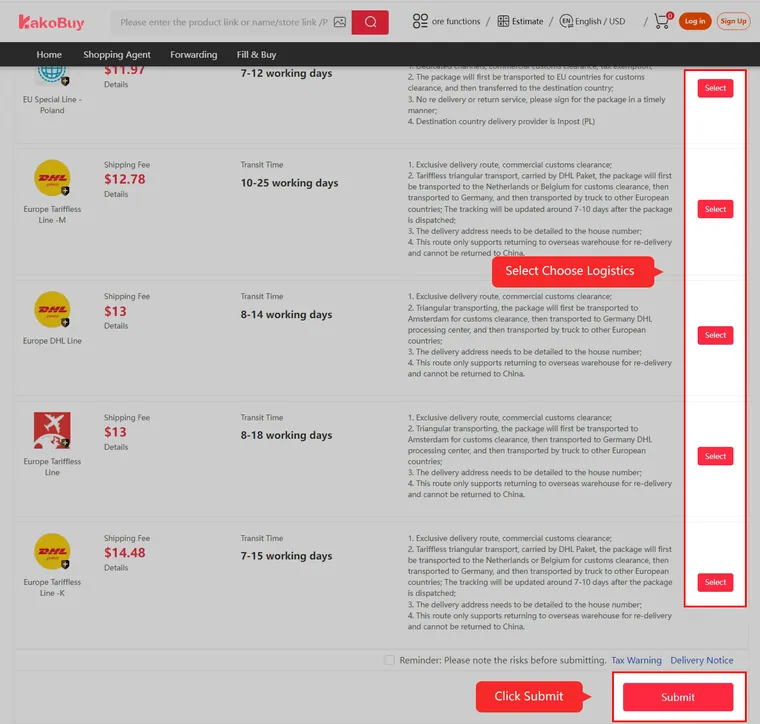
Before anything flies, consolidated freight rolls through aviation security. The operator's published risk notes name what fails the scan: products that endanger flight by transmitting or interfering with signals, flammable and explosive goods, and products suspected of being counterfeit or substandard. Customs export rules add batteries, powders, liquids and precious metals on restricted lines.
This is why route lists read like chemistry labels. Lines announce themselves as battery accepted, no batteries, or electrified, and several state outright that charged, magnetic or pure-liquid products are not accepted at all. The screen in the picture is the Poland list from the operator's own tutorial, and every second line note is about what the belt will not take.
The same risk notes are honest about the handling after the belt: transfers involve rough sorting, and outer boxes do get damaged when freight is unpacked and repacked between carriers. A crushed corner at delivery often happened here, a continent before your courier touched it.
The stranger lines of the prohibition list
The delivery protocol's banned list is mostly what you would guess, explosives, currency, perishables, but its edges reward reading. Live animals are banned with three printed exceptions, bees, silkworms and leeches, provided the packaging protects the courier. A parcel sealed with metal buttons or anything sharp-edged is refused not for its contents but because it can wound sorters and tear neighbouring mail. And improper packaging is a listed offence in itself: a box that might leak, stain or endanger equipment fails before any scanner sees inside it. The belt judges the box as a physical object first and a shipment second.
the customs shed
Random inspection, and the three features that attract it
Clearance at the destination border is a lottery by design: the operator's clearance instructions say inspection is basically random. But officers pull what looks unusual, and the published triggers are concrete: a parcel that is large, heavy or contains sensitive goods. Weight has a named threshold upstream of customs too, since the retained help article warns that a box over 10kg may attract commercial-shipment questions, and a box full of identical items reads commercial at any weight.
A pulled parcel becomes a phone call or an email to you, not to the agent. Officers ask the recipient for invoices or clearance documents; the operator will supply a screenshot of your payment order, and states plainly that it provides no merchant invoice. If the recipient cannot be reached or declines to cooperate, the cost of returning or destroying the box lands on the recipient. The retained duty-free-line notes describe assistance and reimbursement under their conditions; verify the actual selected route and required evidence before relying on this.
One category is hunted at both checkpoints in a row: goods suspected of being counterfeit fail the aviation screen by the operator's own risk notes, and the same notes put counterfeits first on the list of what customs inspects for. The operator's separate anti-counterfeit policy bans them from the platform outright, so a listing that pretends to be a famous brand risks the account as well as the box.
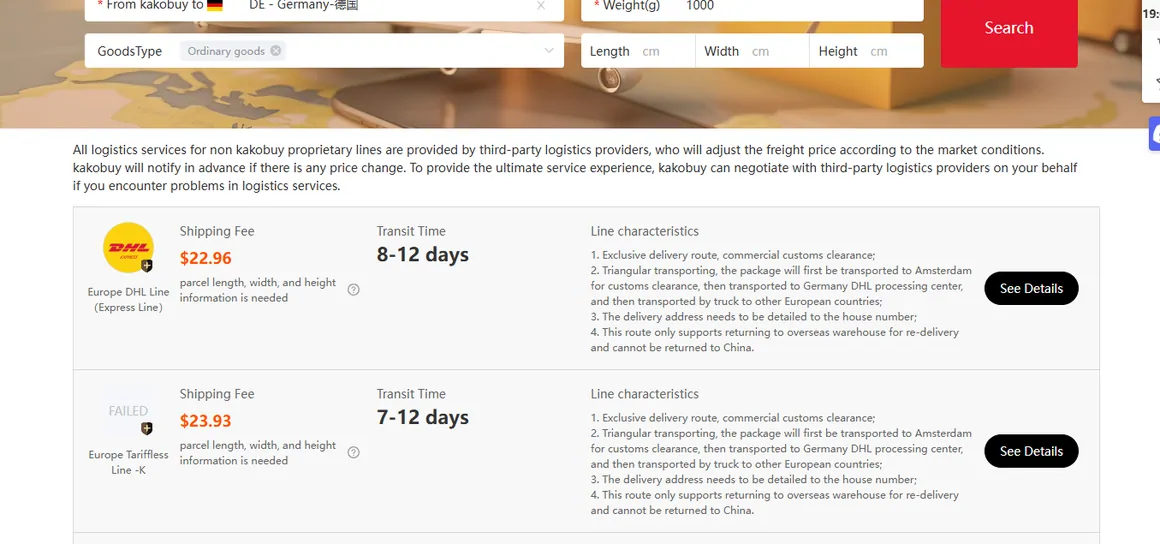
Geography can be part of the design. The German economy lines describe their own path as triangular: flown for customs clearance in Amsterdam, trucked to a German DHL processing centre, then distributed by road. Your tracking shows a Dutch event before any German one, and that is the route working, not a mis-sort. The same route notes demand a delivery address detailed to the house number.
A duty change the operator folded into freight
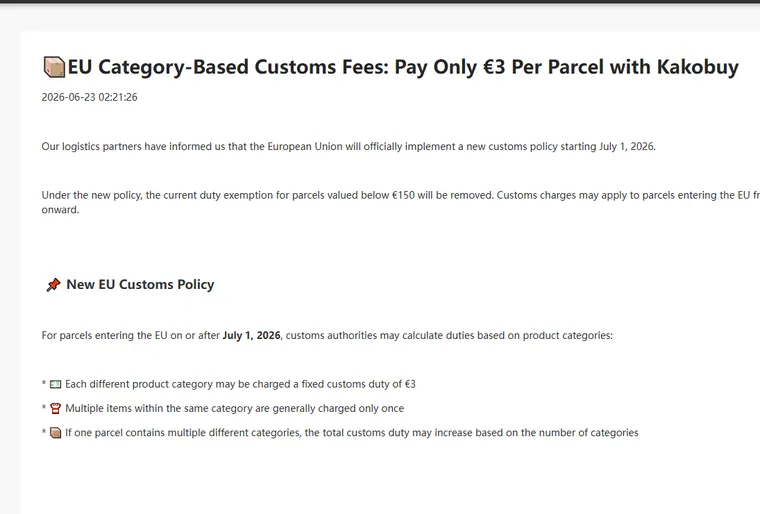
The operator’s June 23, 2026 announcement describes an EU category-based duty change from July 1. The operator's announcement of June 23, 2026 commits to covering everything above EUR 3 per parcel, collecting that euro figure inside the shipping cost at submission, however many categories the box mixes. A week later it confirmed its duty-free EU lines continue with applicable taxes and duties included. For US buyers the equivalent note is older: tax-free routes announced April 17, 2025, priced roughly 5 to 10 dollars above comparable USPS lines, while non-exempt routes leave clearance to you.
Announcements age. Both EU notes reserve the right to withdraw with notice, so treat the dates above as part of the fact, and re-check the announcements board before relying on either.
If a clearance request arrives
Match the tracking number and recipient to your parcel, then open the carrier’s official tracking or support channel to confirm the request. Read exactly which document, response channel and deadline are required. Do not infer a demand is valid merely because it mentions a carrier name.
Use accurate order and payment records for the contents actually shipped. If the operator can provide only an order-payment screenshot, ask the requesting carrier whether that meets its specific requirement; do not label it a merchant invoice. Keep the request and your response together, and contact parcel support for any assistance included in the chosen route.