
The doorstep, where the journey ends and claims begin
Leg three of three, stops 08 to 10
Policy and interface examples below come from official captures checked on 10 October 2026. Timings are published indications, not guaranteed delivery dates. Older UI amounts, offers and routes are illustrative; current order terms and checkout govern. Open an image for full size.
The last hands on the box belong to a carrier in your own country. This leg looks the most familiar and hides the strangest rule in the whole journey: on several routes a parcel that fails here can never go back to China.
Of the three stops on this leg, two belong entirely to your local carrier, which means your national consumer habits finally apply: their app, their pickup points, their redelivery forms. The agent's systems only come back into play at the signature, when the condition of the box becomes a claims question.
the destination network
A local carrier takes over, and tracking lags behind
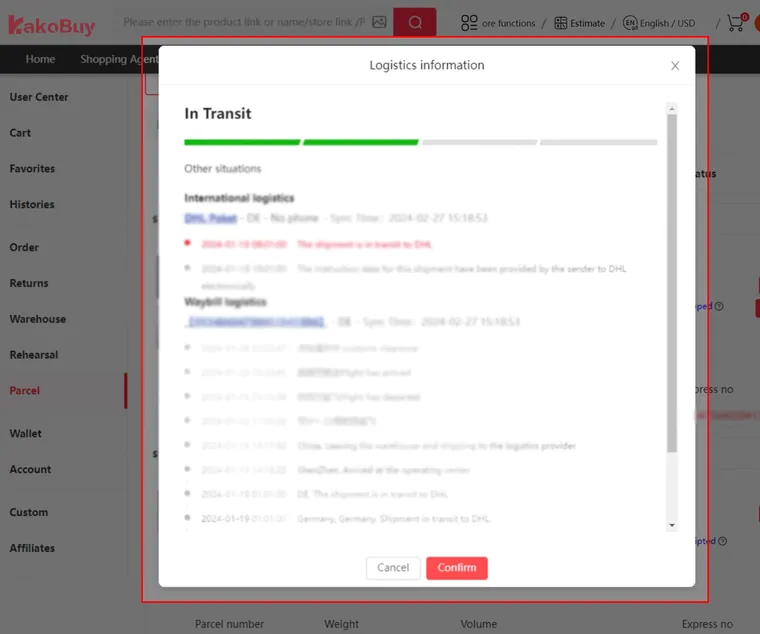
Hand-over happens at a processing centre: DHL Paket, DPD, Royal Mail, InPost or USPS depending on the route you chose back at the packing bench. From here events come from the carrier's scanners, and the operator's tracking page syncs them with a lag it warns about itself, since several parties feed one timeline. The real tracking modal in the screenshot shows the shape: international events on top, waybill events below, flight arrivals, a customs release, then suddenly very local lines.
Which network takes over is decided by the route name you picked at submission, and the names are literal: a DPD line hands to DPD, the Poland special line's notes name InPost as the destination deliverer, UK lines name Royal Mail delivery at the end, and the German DHL lines end in DHL Paket. Pick the route and you have picked the stranger who will knock.
The two streams in that modal are different machines logging different doors: order states from the platform, scan events from the carrier. A box can be days deep into carrier scans while the order status still reads a stage behind; the streams sync on their own schedule, not yours, and the lag is documented rather than suspicious.
If the timeline confuses you, the status decoder on the tools page translates each phrase into where the box physically is. The short version for this leg: once you see a scan from your own country’s network, compare the local carrier’s own events and contact it for delivery arrangements. Keep the agent parcel record for support and any claim.
the missed knock
Unsuccessful dispatch, and the routes that cannot send a box back
Unsuccessful dispatch has a precise meaning in the operator's help pages: the courier attempted delivery and nobody signed, because the recipient was away or unreachable. The box then waits at the local depot. The published advice is to contact the local carrier with your tracking number for redelivery details, while support can query the carrier from its side.
Two address fields decide most missed knocks before the van ever leaves. The parcel return article lists them: an address wrong or too vague for the network, and a phone number the destination country cannot reach for clearance or delivery questions. German route notes go as far as requiring the address detailed to the house number.
Insurance must be considered under the selected route’s terms. The retained policy describes a delay benefit of 20% of shipping after a route-dependent 30- or 40-day threshold from shipment; it does not mean that every parcel that misses an estimated date is covered. Loss, damage and customs-related claims have separate eligibility and exclusions. A wrong address or fragile-item exclusion is not removed by buying insurance.
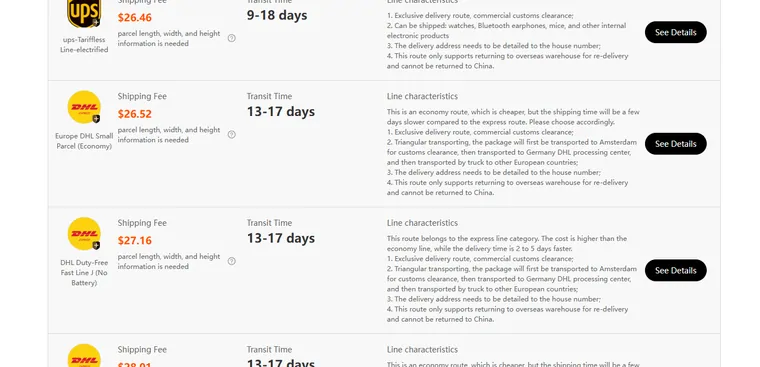
The strangest printed rule sits in the route notes: several European lines state that a failed parcel only supports returning to an overseas warehouse for re-delivery and cannot be returned to China. Miss the knock on such a route and your box's whole possible world shrinks to one warehouse on your continent. Getting the redelivery right matters more there than anywhere else in the journey.
the signature
Inspect delivery and keep evidence
The operator's signing notice reads like a checklist because it is one. Before signing: look at the outer casing, check the sealing tape is the original, and judge whether the weight feels plausible. If anything is off, inspect in front of the courier and either write the problem on the receipt before signing or refuse the parcel outright. A note scribbled on a courier's receipt is the single cheapest piece of evidence you will ever create in this process.
Damage found after a clean signature still has a path, but it is narrower and it has clocks: keep the box and the original tape, report to your local post office within 2 days of signing where the carrier requires it, and report any abnormal parcel to support within 72 hours. Confirm the applicable claim terms promptly; signing does not replace keeping evidence of a genuine problem.
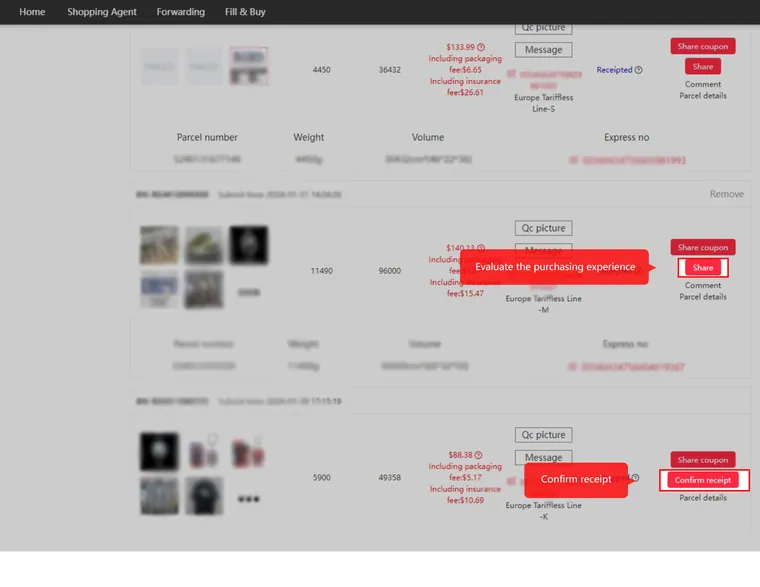
After a clean handover, one click remains: confirm receipt in the parcel list, which the tutorial treats as the formal end of the order. The same row offers the share and comment actions the operator rewards under its posted bonus-point rules; neither is required, and neither extends any window.
The parcel list in your account keeps the journey's receipts: packed weight, measured volume, the freight paid with packaging and insurance itemised, and the confirm receipt button that closes the file on this one box.
Tracking says delivered, but you cannot find it
Check the local carrier’s delivery detail, address, collection-point instruction and any delivery proof. Check an authorised safe place or household recipient where applicable. Keep a screenshot of the event; do not confirm receipt in the agent account while you are still trying to establish delivery.
If the parcel is still missing, contact the local carrier with its tracking number and request a delivery enquiry. Tell Kakobuy parcel support the parcel number, route, last event and carrier case reference. Record when both contacts were made. A delivered scan, a clean signature and an insurance decision are different records; do not assume one automatically resolves the others.